

Infiltration ld exercise
LEVEL DESIGN | UNREAL ENGINE | SOLO PROJECT | 2025


goal of project
Quick description of Infiltration LD exercise and the goal of the exercise
This is a level design exercise for a third-person shooter with climbing mechanics similar to Uncharted or Tomb Raider. The player is tasked with infiltrating an enemy base, collecting a confidential bag from an upstairs office, and leaving the same way they entered without being spotted.
The main goal of this project was to challenge myself through a level design exercise and learn from my mistakes. I gave myself a maximum of two months to complete it, even though I could only work on the project a few hours a week. This was strictly a level design exercise, so I did not implement any gameplay mechanics or scripts.

level design process
Describing my process on making the level
Sketches
I first started by drawing rough sketches of the enemy base. I made a list of the possible rooms I wanted to include and came up with an initial idea for the terrain surrounding the base. My very first sketches were a bit convoluted and confusing, and the room placements didn’t make much sense.
I also wanted to add an area nearby that would act as a starting point for the enemy base. This area eventually evolved into a separate building that would function as a sewer area for the base. After reviewing several floorplans of real life large offices and buildings, I came up with the whiteboard sketches shown on the right. I was also planning on adding a basement to the building, but time constraints toward the end of the project limited that idea.
Once I was satisfied with the floorplans, I moved on to designing the surrounding terrain. I wanted to include a vantage point for the player, as well as some form of a tutorial path. This is when I came up with the idea of having the player start high up on a mountain and travel through a cave that leads to the sewer building. This approach helped me achieve the two goals I had for the terrain, and it also helped me brainstorm additional paths the player could use to enter the base.
Sketch

first & second floor plans


Terrain sketch

Sculpting
I first started by creating the mountains, using a cube to represent how large the entire base would be, as well as the river alongside the base where the sewer content would be disposed of (typical bad people stuff). After that, I added a small area in the mountains to serve as the player’s spawn point, the main vantage point of the level, and the cave entrance.
One thing I added was a small mountain range next to the cave. I wanted to limit how much of the enemy base the player could see in order to build up a sense of curiosity as they progressed through the cave. I also wanted the player to traverse an area that was easy to follow so they could learn the controls before moving on to the rest of the level.
The cave consists of multiple ledge grabs and floor gaps that require jumping. I also wanted the player to understand that there are different ways to tackle an obstacle. Because of this, every ledge grab in this section is technically optional—the player can simply jump over any obstacle they encounter.


blockouts
Filling up the level | Final Details
Once I had everything blocked out, I moved on to replacing the basic models with art assets I had been collecting. This is where I ran into one of the bigger problems with my level (which I will talk more about in the self-critique section). Unfortunately, I overestimated the size of the art assets when creating my blockouts, which led to some difficulty filling larger empty spaces.
This issue ultimately helped me come up with a solid solution. I started experimenting more with the art assets and was able to create some interesting paths for both the enemies and the player.


Final pictures


Level Design Rationale
Explaining why I chose to do a certain design
Cave Entrance
Since this is the very beginning of the level, I wanted to immediately create a sense of curiosity and eagerness to explore. To achieve this, I included a vantage point early on while still obscuring part of the level. In this case, the obscured element is the sewer building just outside of the main base.
From this vantage point, the player may be able to spot a few possible ways to enter the base, such as windows leading into the power room or the bathrooms on the second floor. These entrances help the player begin planning their next steps as they progress through the cave.


two paths
After going through the cave, the player is presented with a choice between two paths. Based on the vantage point seen earlier, the player might be able to assume that one path leads into the base while the other leads outside of it. The outside path eventually leads to the sewer building that was not visible earlier.
I wanted to introduce player choice immediately after the tutorial section. Since the goal of the level is to allow the player to reach the objective through multiple routes, this early but simple decision helps establish that theme.


Player Choice
One of the core game design pillars I wanted to focus on in this level is player choice. I expressed this through the different paths the player can take to reach the objective. To the right are a few examples of this theme being present throughout the level. While each path ultimately leads toward the same goal, they offer different routes and encounters. This allows players to choose a path that fits their preferred playstyle or creative approach.
By presenting multiple routes, the level encourages replayability while also giving players the freedom to adapt their approach based on playstyle and curiosity. Showing these paths also helps players plan ahead, including how they might navigate the space on their way back.




self-critique
Who are the enemies and how they interact with the player
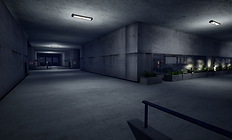
I have a lot of critiques about my design and learned a great deal throughout the process of making this level. As stated before, I severely overestimated the size of my blockout shapes. This resulted in areas with too much empty space that even props couldn’t effectively fill when I replaced the blockout shapes with art assets. This issue is especially noticeable in the café/resting area, the first-floor hallways, the shipping container area, and the power room.
My second biggest issue was struggling to give some of the rooms a better purpose. Sure, the player can go inside these rooms and look around, but what’s the point? Not every room needed a gameplay function, but some of these “empty” rooms should serve a level design purpose beyond simply filling space. For example, they could have included a different path through a hole in the wall, or a hallway filled with enemies that forces the player to enter one of these rooms to find a safer route.
My final major critique is the somewhat boring layout of the base itself. My intention was to create a modern warehouse or factory that would function as an enemy base of operations. However, I feel that the practicality of the layout ended up overpowering what could have been a more engaging and fun design.

